ABA ابّ ا.

Sulaf

Released 09 October 2026

  1. Intro
  2. Bitti Alhitali
  3. Intro Shogi Ana
  4. Shogi Ana
  5. Outro Shogi Ana
  6. Marhab Ya Alrasool
  7. Outro Marhab Ya Alrasool
  8. Sameen
  9. Naada
  10. Allah Ya Allah

Liner notes

I gathered my belongings into a small bag, not shedding many tears. As no one expected what would happen; no one foresaw all this separation. Three years have passed since then.

I carried laughter, conversations echoing in my mind, and faces in my memory, and songs I returned to whenever distance and exile grew heavy, songs that softened their grip and reminded me that I come from somewhere, that I have roots and meaning, that I am a daughter of all this beauty and love. I have always been drawn to the past, how people lived, how they loved, and what life meant to them.

Aba was a loving, wise, and gentle man. A man who loved without distinction, a friend to all. I witnessed his love for his daughters Shadia, Nadia, Hadia, Radia, Samia, and Maria, so complete that, as a child, I believed no father could love the way Aba did. Though I did not have much time with him, he left something enduring behind. A quiet breeze of love and admiration, carved into my soul early on.

I still see him clearly: lying in his bed, a small table beside him, holding the simple belongings of his life — brown glasses, a radio, and a hugga of tumbak (small box for chewing tobacco).

He looked like Sudan. The Sudan that lives inside me. A simple Sudan, generous, with a vast and open heart — the Sudan I loved, and never imagined I would one day see so changed.
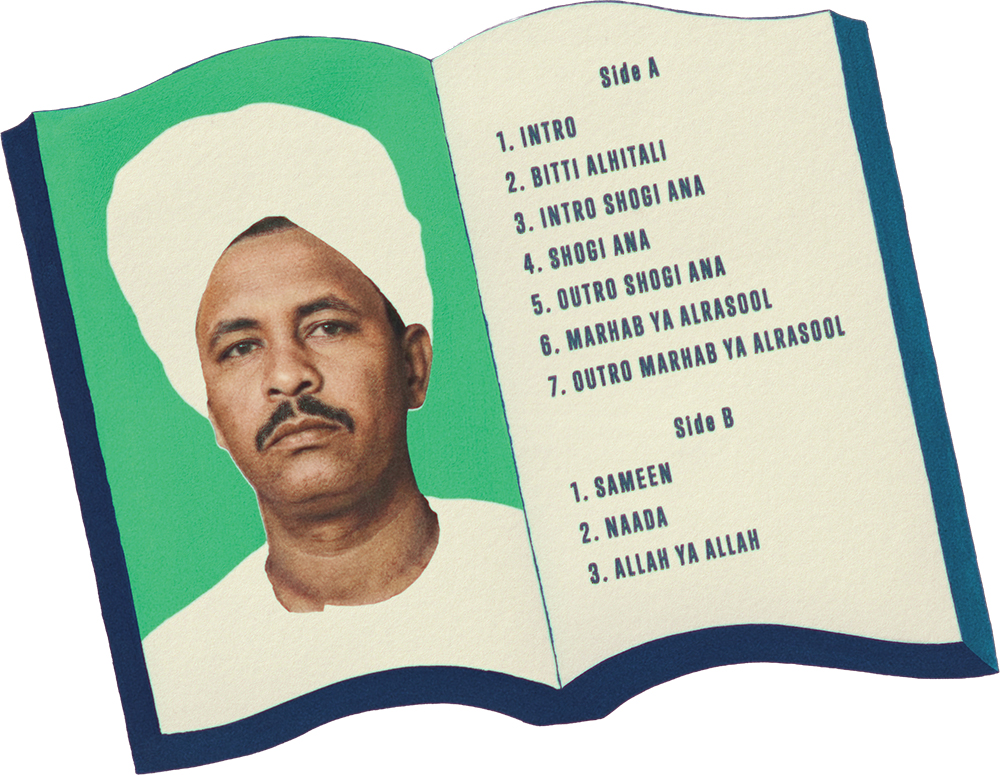
ABA album tracklist, with picture of Sulaf's grandfather Aba.

This leaves me wondering: How do we carry yesterday’s Sudan into tomorrow? What stories do we pass on to our children, and to the world? How do we keep these meanings alive, when we are all scattered everywhere? These questions are one of the main reasons for this documentation, and to name the album ‘ABA.’

One of his daughters (Samia), who was deaf, called him Aba instead of Aboy or Yaba and the name stayed. These songs have always been my naffag, a small window into Aba’s world. Through them, I return to my Sudan. They are also part of what he left behind. It aches to know that everything he wrote lived in a single notebook, now somewhere in Khartoum. I do not know whether it was destroyed, taken, or simply carried away by the wind into the unknown. What binds these songs together is love, the timeless love that brought Eve to Adam, and that keeps Aba alive, now and forever.

Words by Sulaf

Sulaf - Naada (Lyric Video)

Credits

Musicians: Maxime Kosinetz: effects (1, 3, 5, 7), synthesizers (2, 4, 6, 7, 8, 9, 10), programming (2); Emile Larroche: effects (1, 3, 5, 6), synthesizers (4, 8, 9, 10), additional production (4, 6, 8, 9, 10); Amar Chaoui: percussions (2, 4, 6, 8, 9, 10); Christelle Lassort: violin (2); Maxime Daoud: bass, keyboards (4, 6, 8, 9, 10); Adrian Edeline: guitars (4, 6, 8, 9, 10); Sulaf: oud (8, 9, 10); Léonard Desarthe: violin programming (9).

Music written by: Sulaf, Maxime Kosinetz, Emile Larroche (1, 3, 5, 7); Abdelazim Sayed Ahmed, Maxime Kosinetz (2); Abdelazim Sayed Ahmed, Maxime Kosinetz, Maxime Daoud, Adrian Edeline, Emile Larroche (4, 6); Sudanese traditional, Maxime Kosinetz, Maxime Daoud, Adrian Edeline, Emile Larroche (8); Abdelazim Sayed Ahmed, Maxime Kosinetz, Hicham Bouhasse, Maxime Daoud, Adrian Edeline, Emile Larroche (9); Abdelazim Sayed Ahmed, Maxime Kosinetz, Maxime Daoud, Adrian Edeline, Emile Larroche (10).

Lyrics: Sulaf (1, 3, 5, 7); Abdelazim Sayed Ahmed (2, 4, 6, 8, 9, 10)

Recorded at Studio La Hutte, Studio Udo and Studio Red House La Forestière, France
Recorded by Maxime Kosinetz (1, 2, 3, 5, 7)
Recorded by Hugo Zeitoun (4, 6, 8, 9, 10)
Produced by Maxime Kosinetz
Mixed by Hugo Zeitoun
Mastering: Mickael Rangeard
Photography: Elias Borst
Graphic Design: Noé Borst
Make-up: Mélanie Vergnol
Hair: Maryse Kanarellis
Styling: Nesrine Kuku
Jeweller: Kuku Jewelry

Executive Producer: Marion Chapdelaine (Mama Chap)

With the support of Fonds Régnier pour la Création and The Arab Fund for Arts and Culture.

Thanks to: L’Institut Français in Khartoum, La Cité Internationale des Arts, Les Dominicains de Haute-Alsace (Guebwiller), Le Normandy (Saint-Lô), Les Fours à Chaux (Regnéville- sur-Mer), Hicham Bouhasse (Imarhan).
Thanks to Radia Abdelazim, Said Ahmed, Elzahraa Hussein, Masarra Hussein, Mazin Hamid, Nisreen Kuku, Ibrahim Ahmed.

Further Listening

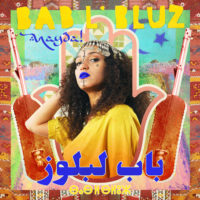
  • Nayda!

    Bab L’ Bluz

    Released 05 June 2020

    Moroccan-French power quartet, Bab L’ Bluz, reclaim the blues for North Africa. Fronted by an African-Moroccan woman in a traditionally male role, Bab L’ Bluz are devoted to a revolution in attitude which dovetails with Morocco’s ‘nayda’ youth movement – a new wave of artists and musicians taking their cues from local heritage, singing words of freedom in the Moroccan-Arabic dialect of darija.
  • BAMANAN

    Rokia Koné & Jacknife Lee

    Released 18 February 2022

    It’s a voice that soars — pure, clear and true — above bass and synths, traditional percussion and infectious Mande guitar grooves. A stop-you-in-your-tracks voice instantly familiar to anyone in Mali, West Africa: Rokia Koné, a.k.a the Rose of Bamako. On her debut album, she teams up with California-based rock producer Jacknife Lee to reimagine the Malian sound in ways both leftfield and beautiful.

Further reading

Totó la Momposina (1940-2026)

Colombia has lost a great cultural icon, Totó la Momposina, who leaves behind a huge musical legacy...

The Breath live at New Century

The Breath live at New Century. New live album performed, recorded and released specifically as an i...

Spafford Campbell: Erasing genre and finding gold in the embers

Jane Cornwell talks to Spafford Campbell about new album Tomorrow Held.

Track of the Day: ‘Niña De La Risa’ by Clara Serra López

Clara Serra López is a Spanish born vocalist, composer, songwriter and keys player based in London...